Property and Freedom Podcast, Episode 300.
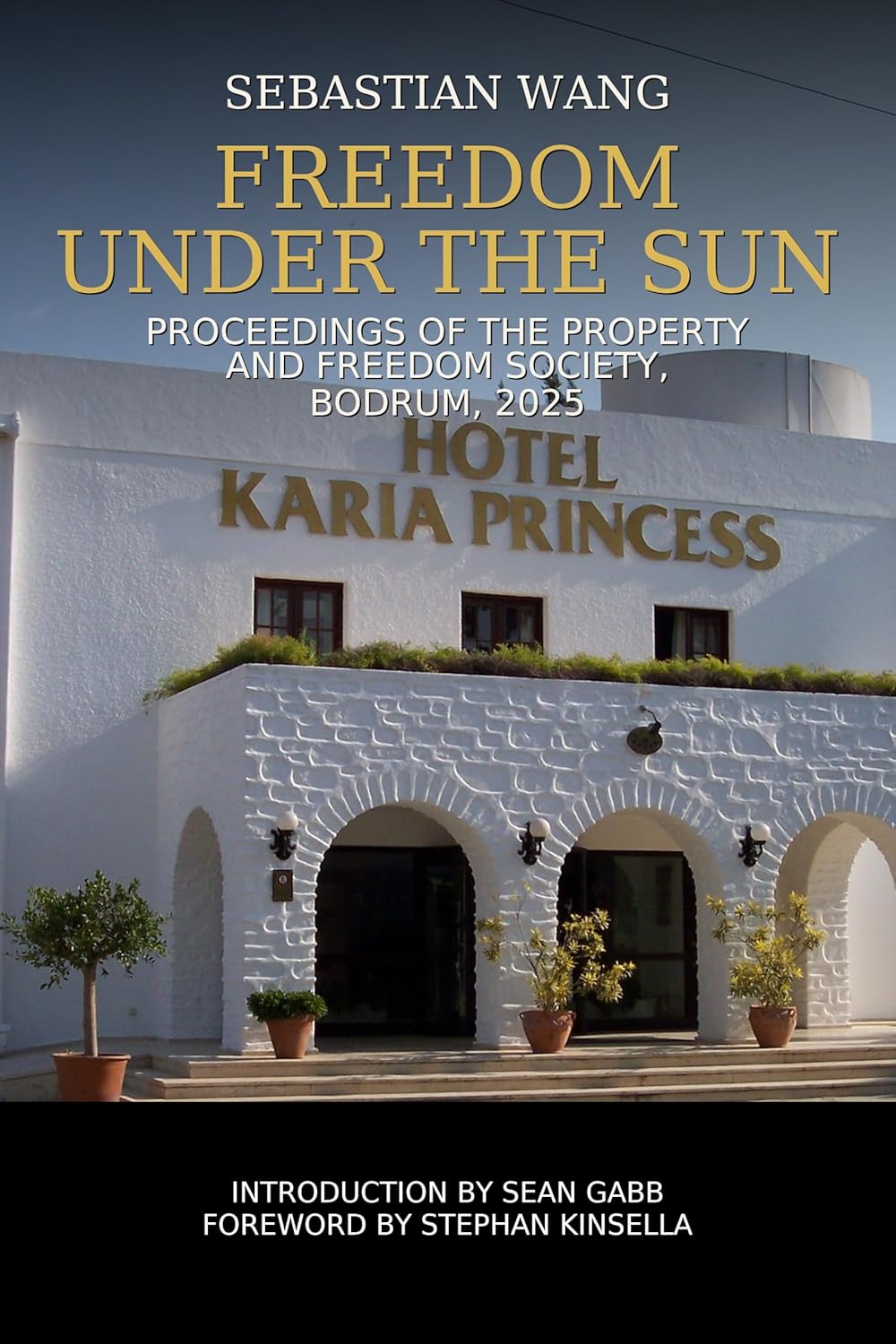
This talk is from the recently-concluded 19th annual PFS 2025 Annual Meeting (Sep. 18–23, 2025, Bodrum, Turkey).
David Dürr (Switzerland): A Brief History of Swiss Anarchism [Sebastian Wang, “David Dürr on Swiss Anarchism – Property and Freedom Society Bodrum 2025,” Libertarian Alliance [UK] Blog (Sep. 21, 2025)] Shownotes and transcript below.
Other talks appear on the Property and Freedom Podcast. Other videos may also be found at the PFS 2025 Youtube Playlist.
Grok shownotes
PFP300 Show Notes: David Dürr – A Brief History of Swiss Anarchism (PFS 2025)
Overview
In his 10th PFS appearance (coinciding with the conference’s 20th anniversary), Swiss lawyer and anarchist thinker David Dürr traces Switzerland’s history through the lens of external and internal anarchism: no vertical integration into larger empires (external) and no centralized monopoly of power within (internal). Far from chaos, anarchism here means voluntary, horizontal structures and resistance to coercion.
Key Historical Arc
- Ancient Roots: Helvetii tribes resist Roman yoke (100 BC); early fragmentation hints at anarchist tendencies.
- Medieval Emergence: Switzerland forms in the 13th century as Habsburgs expand—small valleys and towns band together in defense pacts (Rütli Oath, William Tell myths).
- Holy Roman Empire Era: Switzerland remains a loose, recognized entity among larger blocks; internally a patchwork of cantons, towns, and languages.
- 1515 Marignano Debacle: Attempt to conquer northern Italy fails spectacularly—Swiss lack of centralized command proves both weakness and strength; retreat preserves autonomy.
- Westphalia (1648): Formal external recognition; internal diversity intact.
- Napoleonic Interruption: Helvetic Republic (1798–1803) briefly centralizes; Napoleon admits he cannot coordinate the quarrelsome Swiss.
- Vienna Congress (1815): Restores loose confederation of 22 sovereign cantons—peak of dual anarchy.
The Turning Point: Sonderbund War (1847–48)
Liberal Protestant cantons illegally force Catholic conservative cantons into a unified federal state via majority vote (no required unanimity). Dürr calls this an illegal coup d’état that ends internal anarchism and creates the modern Swiss Confederation.
Modern External Anarchism
- Switzerland stays out of NATO and EU; rejects EEA in 1992 by razor-thin margin.
- Ongoing EU pressure via new bilateral treaties—resistance weakening.
Why the Center Cannot Hold
Switzerland lacks unifying glue:
- Two main religions (Protestant north/west, Catholic center/south).
- Urban/rural cultural divide.
- 26 cantons competing on taxes.
- 4 national languages (German, French, Italian, Romansh).
Dürr predicts breakup by 2048 (Schlussbericht 2048—a satirical “final report” from a dissolved Confederation).
Philosophical Coda
Rejects “nation of will” (Willsnation) as Hobbesian fiction: Leviathan’s composite body has many people but one head. Real unity comes from diverse individual wills, not a mythical collective one.
Teases his pet topic: even strong individual wills are not truly “free”… but that’s another story.
Books Mentioned
- Schlussbericht 2048 (German; fictional dissolution narrative).
- Staat oder Oper (the state as grand theatrical illusion).
A witty, map-rich romp through 2,000 years—proving Switzerland is less a nation than a stubborn anarchist experiment still running.
Grok/Youtube transcript
PFP300 | David Dürr: A Brief History of Swiss Anarchism (PFS 2025)
Introduction and Anniversary Reflections
[0:00]
Don’t applaud too early. You have to endure me now for the 10th time already. This is my 10th anniversary as a speaker at PFS, which coincides with the 20th anniversary of your conference. So that’s a big honor for me, of course, and many thanks again for the invitation to Guido and Hans.
Topic Selection and the Cradle of Anarchism
[0:28]
As usual, since about two or three years, I made a proposition to Hans: what about the topic of free will, which is not free but it’s very useful that we think it’s free? And he always says, “Oh, David, that’s another story. Why won’t you speak about Javier Milei?” That was last year. Or, “Why won’t you speak about a brief history of Swiss anarchism?” That’s a fine idea, that’s a suggestion. I think it’s a good one and not that other story with the free will.
[1:20]
Now, a brief history of Swiss anarchism. This is really something interesting. One could even say that a brief history of Switzerland is anarchism. Maybe this is a fairly good example of anarchism. However you define it, one can say some people say that in 1976 there was a football club Bakunin, and they said—this is what I found on the internet—in 1976 they said Switzerland is the cradle of anarchism. This is a football game of young people; at that time this was about like Hans looked like as a young leftist revolutionary. Maybe he did not play football, I do not know. But when they celebrated Switzerland as the cradle of anarchism, they looked back a century ago when this cradle started to exist.
The 1869 Basel Convention and Bakunin
[2:24]
And they referred to this event in 1869: that was an anarchist workers’ union convention in Basel in Switzerland, the place I live. And the famous, internationally well-known and chased anarchist Mikhail Bakunin spoke at that convention in that beautiful hotel—I know the hotel where it is. And he did not plead against capitalists or bourgeois state or things like that, but against other socialists, against this centralist attitude of Marx. So there were not just socialist leftists but anarchists. This was very typical and important for them, and that took place in Basel. So it seems that Basel is, or Switzerland, let’s say, is the cradle of anarchism.
[3:44]
This is the same convention conference—you see, beautiful, this hotel. This is like anarchists celebrate their conventions, their reunions here at this beautiful hotel with this terrace with the stairs. They all looking friendly at the photographer. This is how anarchists celebrate their convention. [Applause]
Swiss Anarchist Highlights: Geneva Assassination
[4:18]
And of course we are the heroes of anarchism because in Geneva the famous empress was assassinated by an anarchist. So Switzerland is the cradle of anarchism.
Defining External and Internal Anarchism
[4:38]
But after this episode, let me try to go a bit deeper into what anarchism is and namely what Switzerland is about with anarchism. I distinguish between external and internal anarchism. If a country, a population has an anarchist attitude, there is an external, international so to speak aspect, and on the other side the internal one.
[5:13]
The external one means, I would say, not being vertically integrated into a bigger entity, not just being a small part of a bigger thing. This is the external aspect of anarchy. Anarchy which means—without a Greek—which means first superior, without central monopolized power. This is anarchy, and this is the meaning if you look at the external aspect of anarchy. What is not excluded is that you have horizontal contractual relationships that can be binding, but it’s not a vertical integration. That’s the external aspect.
[6:07]
And now the internal one: this means that internally, within this group, within this population, within this country, there is no center of power. There is no involuntary collectivity. This is the meaning of the internal side of anarchism. But here again, what is not excluded is that there are centers—in the plural—centers of power: economic centers, scientific, cultural centers, whatever, with voluntary memberships. So anarchism does not mean lack of structure, lack of organization, but no integration outside and no monopoly inside.
Early Swiss History: Helvetii and Resistance to Rome
[7:01]
What does this mean now for Switzerland? The Helvetia, Switzerland, Confederatio Helvetica. This is the official notion. Helvetii, maybe from the very beginning this was a small population somewhere in the place where today we have Switzerland. This is a beautiful picture when they defeated the Romans in one battle somewhere around 100 before Christ. They tried at least to resist the Romans at that place when they forced them under the yoke in this beautiful picture here. That was an exception, by the way. On the long run they could not resist, but that was the attempt to get external anarchy, not to be integrated.
[7:58]
Internally, they were maybe at that time already truly anarchist because even Helvetii—that was not even a tribe. These were three smaller tribes somehow bound together. So maybe the tendency was at those earlier times already with those people that became afterwards the Swiss—you know—was anarchist.
Roman Empire and Early Middle Ages
[8:27]
Now a bit later, 100 AD, we have this Roman Empire that grew and grew. We have these red Italian parts. We have the provinces there. But in these provinces you do not find any Helvetic province or Swiss province or things like that. In that area where today Switzerland is, there was nothing specific. There was not an entity, neither externally nor internally. So that’s not yet the anarchist Swiss Switzerland.
[9:08]
Now a bit later, early Middle Ages around 1000 AD, we have a multitude of medium-sized entities beginning to form a horizontal, essentially horizontal empire. So the well-known Holy Roman Empire of German Nation—that’s in principle a horizontal organization of smaller and bigger entities. And this is that situation. Here you see some entities like Burgundy, like Swabia, like Bavaria, and here northern Italy. So relatively big blocks that have some tendency to coordinate among them. Switzerland as such is not there yet at that place. What is interesting is that it’s not within one of these blocks; it’s somewhere in between. It’s maybe it once then will be just a leftover of bigger blocks, and one sees that a little bit here in this graphic already. So still neither an internal nor external entity so far.
Emergence of Switzerland Against Habsburg Growth
[10:27]
And this changes now around 1300 with the beginnings of the Habsburgs, the Habsburg family becoming a big entity, and not by accident within the same period of time. These are the beginnings of Switzerland as an entity refusing being part of a bigger entity. So while Habsburg is growing up, there is something that resists becoming a part of it, and this is Switzerland. So it starts to form itself from an external anarchist approach. Not yet with these frontiers, with these borders, but you see between these red parts—this is Habsburg. These red particles—it has to do with the edges of this empire starting to grow up and to form itself internally.
Myths of Swiss Founding: Rütli Oath and William Tell
[11:46]
This is then the famous myths of the oath of Rütli and of William Tell. I presented two or three years ago. Internally that was anarchy. That was not one small state. That was more or less a defense treaty between small populations and places and churches. So one could say—we heard before—Switzerland is the cradle of anarchy. One might say anarchy is the cradle of Switzerland. If this is true, I don’t know. It’s wishful thinking perhaps.
Swiss Stability in the Holy Roman Empire
[12:29]
Then the Holy Roman Empire has developed. In this context, Swiss became something like a relatively stable place, internally still completely anarchist with many places, cantons and towns and areas and different languages, still but more or less accepted from the places around that it’s Switzerland. In the meantime, other big blocks have developed. On the left side here, you see France that still was big before. On the right side, you see Habsburg—not yet that big. You see even more to the right side, Hungary. So that later on became the big double monarchy of the Habsburgs. And in between you have these many small states formed together as this holy empire. Within them the Swiss as not the smallest but one of the middle-sized or small-sized entities.
Failed Expansion into Northern Italy (1515)
[13:41]
And at that time—this is historically interesting—the Swiss had the idea: now we too, we too. Yes, we too, we will become a big entity. And they saw there were some difficulties in northern Italy between France and Habsburg. And that could be a good opportunity to expand. And maybe that was a mistake in 1515. It was an attempt to expand by conquering these northern Italian parts, Piedmont and Lombardy. And I would say that was a contradiction to the principle of internal anarchy. That was an effect outside, of course, but maybe it’s an aspect of internal anarchy that they conquer and they force, for instance, these Italian parts into their own entity. So that’s a contradiction to an anarchist principle. By the way, anarchist principle that never was declared—I’m just describing what went on.
[15:13]
But the French king did not like that. And he was much stronger at that battle there with Marignano, at Marignano, a small place there in northern Italy. The Swiss were heavily defeated, and they were defeated probably because they were good anarchists. They were not able to coordinate their military movements, and that’s why the French king was much stronger and destroyed the army completely. And they withdrew—at least they could maintain their internal anarchy, or they went back to their internal anarchy, and they could remain, they could keep their external anarchy. And so the king, the French king, did not integrate them. He hired them as mercenaries afterwards.
Peace of Westphalia and Swiss Recognition
[16:12]
Okay. Then we have this Holy Roman Empire even a bit later, at the time you Alessandro mentioned before with the Peace of Westphalia. And here we see again now this better organized structure of Europe with countries, with states. So this was a sort of new and reorganized form how society organizes itself, and you see here Switzerland. It looks a bit like a big unified country on this map, which is of course not true. If you look closer at Switzerland in the external aspect, you have still this anarchy. So all these states around, partly newly formed states, accepted Switzerland as an entity to be respected. They were not integrated, and Switzerland internally—and now this map is just not precise—internally it looked like that. So that would be the true map of that situation with these different cantons and languages and things like that. Of course there is something around Switzerland but not a unification. So externally granted, internally not challenged, they within this group remained anarchist.
Napoleonic Interruption and Helvetic Republic
[17:49]
That changed actually only a bit later with Napoleon. Here we see the big Napoleon Empire and Switzerland just as one province so to speak, one part of this big empire here of the French Empire. And here again this old name Helvetii I mentioned before came up with the Helvetic Republic implemented by Napoleon. That was an interruption, one could say, of the external aspect of anarchy.
[18:29]
While—and this is interesting—the internal, you see that it was not just a territory, a sub-territory of France. Again, if you look at it more precise, there was still this diversity, and Napoleon who tried to organize all these Swiss—once he gave up. He said, “Even I, Napoleon, am not able to coordinate these people because they always have conflicts between them,” which is a good anarchist attitude, you know, not to kill each other, but at least to fight maybe more than others do. So one could say internally they could resist in a certain way to Napoleon.
Vienna Congress and Loose Confederation (1815)
[19:10]
And then after Napoleon, so we have the Vienna Congress 1815. Actually that’s now the end of history, one could say and hope for Switzerland, one could say at that time, because back to external anarchy—Napoleon is pushed back—while entering internally into a more specifically designed and organized but still horizontal confederation, a loose confederation of 22 independent cantons. This was not a state. This was a federation. So the internal aspect, internal anarchy, was upheld or even underlined and enforced, enhanced against before. So one could say that’s fine. That’s now the end of history. We have Switzerland with external and internal perfect anarchy. But as you know there is no end of history.
Sonderbund War and the 1848 Coup d’État
[20:35]
And then came this famous Sonderbund War. That’s the episode I mentioned already once here in this group. These were tensions between liberal and conservative cantons. These here in the map, the green parts—these are mainly Protestant, not the chino but they were liberal cantons—while these lilac-colored parts were the Catholic centers, mainly in the center of the country and south in the canton of Valais. So these were typically Catholic, pope-oriented also some of them, and conservative structures, but they were members of this loose confederation of these 22 cantons.
[21:48]
And then these liberals, these so-called liberals, became quite aggressive and tried with really illegal military force to force cantonal canton like Lucerne for instance to push away their government and implement new liberal governments, things like that, which led to this Sonderbund so that these Catholic cantons formed a new coordination of defense so to speak, this Sonderbund special federation. And the Protestants, the liberals actually who gave birth to this conflict—they went into this war, this civil war, because they were more cantons, they were stronger militarily. They defeated these Catholic cantons, and they did not just force them to dissolve the Sonderbund; instead they enforced them to become a member of the whole confederation.
[22:58]
So they formed out of a loose confederation a state, new state with sub-parts of course, but these sub-parts, these cantons, were not independent subjects anymore; they were part of this bigger, relatively bigger country and bigger state, Swiss Confederation. That’s a coup d’état actually, and it was against international and constitutional law because for such a step unanimity would have been required, and that was with majority. So that was illegal. So the foundation of the famous liberal democratic Swiss Confederation was an illegal coup d’état. So that was the end of the internal anarchy, and this is still the situation we live in.
External Anarchism: Resistance to NATO and EU
[24:01]
At least one could say the external situation remained anarchist. So far more or less Switzerland could resist to international pressure to become member and integrated into bigger organizations such as the NATO there. Switzerland is not member. You see that? I had to look quite long on the internet for a map where this conglomerate like NATO is marked in red—usually it’s blue, and in the east it’s red, but I thought it fits more in my graphics. For me the blue ones are the good ones, and the red ones I have some hesitation. So well, that’s—but I found that somewhere, and here in the external relationship Switzerland is still anarchist, one could say.
[25:03]
And the same is true for the European Union, which started not as a union of course—this EEC initial forms—and then more and more developed until 1992 to the Maastricht Treaty which created this EU, European Union. And here you see as an idol so to speak in this big red part, you see this still anarchist, at least in the external relation, this anarchist Switzerland.
[25:42]
At that same time when this Maastricht Treaty was signed, Switzerland had a vote about not EU membership but a loose form of cooperation, this European Economic Area, and they declined. It’s a very close vote, some small 51% or something like that that went against that, and I think that’s not a bad step for Switzerland at least externally to maintain their anarchist attitude. Of course there are ongoing pressures coming from outside from this red place here to integrate Switzerland currently. Now there are new contracts with EU that will be put to vote somewhere maybe next year or so. So this is a really actual topic, and the resistance against that is perhaps weakening. Let’s hope that it goes in the right direction.
Internal Diversity and Prediction of Breakup
[26:53]
But I would—for the end, I have some more minutes I guess, is that okay?—come back to this internal anarchy that is not lost. But that at that time in 1848 after this Sonderbund Krieg, this internal anarchy was sort of abolished or overcome in a way. And I still would say but this is not true. And then because it’s not an entity, it cannot last too long. I could imagine that it breaks apart somewhere earlier or later, and because once you look at it there is nothing in common. There is diversity however you look at it.
[27:57]
For instance, this was actually the situation with the Sonderbund Krieg—not precisely the same map but more or less—with the religions. With more or less it’s not that much divided anymore than 150 years ago, but still you have traditionally Protestant areas and Catholic ones in the south and in the center Catholic, in the middle of the country, and for instance in Basel where I live and in Zurich of course they are traditionally Protestant. So there are two main religions, no unity that could be the basis for one state.
[28:49]
Or we have topographical and therefore cultural differences. There is a difference—you know that from other countries too—between city population and land population; the cities are leftist and woke, while on the countryside they are more conservative. So you have these differences here too. So there too you do not have some common unity. Of course these 27 cantons that are not independent states anymore of course but they are something still, and there are in certain aspects there is also a competition between these cantons, for instance in tax relations—some cantons are cheaper than others. And so there too you do not have unity; you have 2,000 communities.
[29:48]
And then of course—and that’s the main point—still for languages, and in other countries it’s I think a dominant aspect how a culture develops along at least one main language. Of course the bigger part is German, but at least German and French and also Italian—they play a role. And this is not a unity. This is a diversity. We have here these smaller parts, this yellow—this is Romansh, which is not a big part, but nevertheless it’s a fourth language. And you see also a bit the map we saw before at the beginning here—that was former Burgundy, that was the Holy Roman Empire. And here we have Piedmont and Italy. So you see Switzerland as a leftover between these big blocks. You see that with the language. So there is no common element I would say holding Switzerland together. And therefore I’m quite confident that this breaks apart somewhere.
Fictional Future: “Schlussbericht 2048”
[31:04]
This is what I wrote in my little book that is also on the book table here. And “Schluss” means final report. It’s in German. So either you know German already or you have to learn German, and then you can read this book. Or I can translate of course. So final report—this is looking back 2048, precisely 200 years in the same room as 1848 when the new constitution was decided with that illegal majority I mentioned before. And 200 years later they look back and say now we have liquidated this; a lot of people did not remember even that once upon a time there was something called Swiss Confederation. “Oh yes, there was something.” Yes, in the meantime I thought that is over already. So this is the situation in that book. So one could say in 23 years from now this internal anarchy could be restored. Of course the external hopefully will be maintained.
Critique of the “Nation of Will” Concept
[32:16]
And once you go to this book shelf there is also another book that I made earlier, “Staat oder Oper”—that this is all just a brilliant opera they perform, you know, that people believe in the state which of course is just an opera. There are still some that resist against this anarchist ideas and say, “No, no, no. We have something holding it together. It’s a nation of will. Not a nation of language, not a nation of religion, but of will. Free will. Free will.” That could be a well, but that’s another story, you say. So a nation of will.
[33:04]
And then I asked, but where is this will? And it reminds me of this gentleman here. You certainly know Leviathan by Thomas Hobbes out of that time already mentioned also by Alessandro before. And it’s this theory: there are many people—you know this body is composed of many many many people of this population—and their wills so to speak are put together, and up there there is one will who coordinates this. This is one will of all these people here, which is of course a theory, a fake which is not true. There is no such will.
[33:56]
If you look at this, it’s revealing in a way. It’s unmasking this sketch. The body is composed of many many people, but the head is not. It’s just one head, a relatively big one but just one, you know. And this is what this arist scheme is about. There is one will or maybe of a very short group which should be decisive for this whole country. So if they speak about the nation of will, they have an idea something like that. And once I say there is no such one will up there, and we saw that this is just a theory, so this does not fit to our country.
[34:52]
So one can say in that red part we have pure theory—pure in the sense of not fact-based theory—one will. This is I would say just not existing; this is a theory. So this nation of will approach is a fake, while on the basis we have many wills, many many diverse wills. This is pure reality. So that’s why I can imagine that this lower part has the force to live much longer than something based on this red part.
Conclusion: Individual Wills and a Tease on Free Will
[35:37]
So to come to the conclusion: there is no such thing as a common will. There are individual wills. There can be very strong individual wills. If you imagine some real person being there, strong with a will, wanting to do this or that—maybe brilliant and maybe with visions. It’s different from this fake will.
[36:14]
And nevertheless—sorry Hans—nevertheless I would ask people, you know, real people with a strong will: is this will really free? So that gave me the opportunity to come to this point again and to compare that gentleman with other gentlemen. I would say but that’s another story. Thank you very much.

Podcast: Play in new window | Download (66.8MB)













You must log in to post a comment. Log in now.